
How to Calculate Ready-Mix Concrete for a Driveway, Pad, or Walkway
November 1, 2026
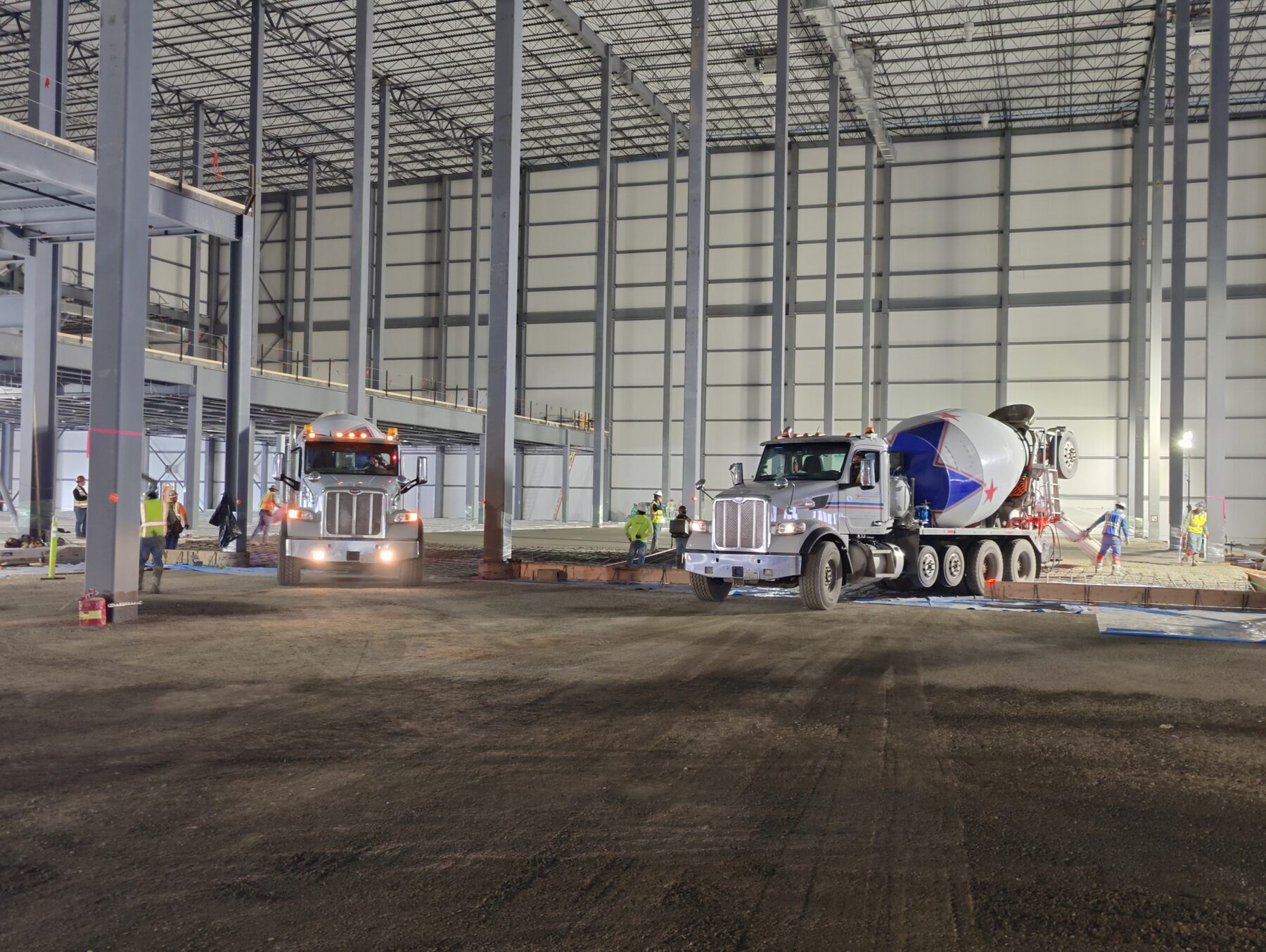
The amount of ready-mix concrete needed for a driveway, pad, or walkway depends on the slab’s length, width, and thickness. Because concrete is ordered by cubic yard, the most accurate way to estimate the right amount is to measure the slab carefully, convert the volume, and account for small variations in the base or formwork before placing the order.
How Thick Should the Concrete Be?
Concrete thickness changes the final volume more than any other measurement, requiring particular attention. A residential driveway carrying passenger cars and SUVs typically pours at 4 inches. A driveway that regularly handles a pickup towing a trailer or an RV usually moves up to 5 or 6 inches, and many get a thickened edge 1 to 2 inches deeper around the perimeter, since slab edges carry tire loads with less support beneath them.
Walkways and most pads sit at the lighter end of that range. A 4-inch slab carries foot traffic and the light, spread-out weight of a garden shed or an air conditioning unit. A filled hot tub or a parked RV concentrates far more weight on a small footprint, so pads for either typically pour at 5 to 6 inches. Any stretch of walkway that crosses the driveway takes on the driveway’s depth for that section.
How to Measure for Ready-Mix Concrete
Form boards set the measurements for ready-mix concrete once the depth is chosen. Length and width get measured inside the forms, in feet, rather than pulled from a site plan or a sketch. An L-shaped driveway or a curved walkway breaks down into simple rectangles that are calculated separately and added together, with any curve measured at its widest point so the estimate stays on the generous side.
Depth needs the same care as the footprint, because the ground under the slab decides whether 4 inches actually stays 4 inches. A compacted layer of crushed base rock, screeded flat to the bottom of the forms, holds the slab at an even thickness from end to end. A depth check at several points along the forms before ordering catches low spots while they can still be filled with gravel instead of concrete.
How to Convert Square Feet to Cubic Yards
Square feet convert to cubic yards in two steps once the forms are measured. Multiply length by width by depth, with depth expressed in feet, to get cubic feet, then divide by 27, the number of cubic feet in one cubic yard. Depth in feet is the inch measurement divided by 12, so 4 inches becomes 0.33 feet and 6 inches becomes 0.5. Batch plants measure ready-mix concrete in cubic yards, which is why every measurement has to end up in that unit.
A per-100-square-foot figure gives a fast way to check the math. Every 100 square feet takes about 1.23 cubic yards at 4 inches, 1.54 at 5 inches, and 1.85 at 6 inches.
Three common projects show how those figures play out. A 12-by-40-foot driveway poured at 5 inches comes to about 7.4 cubic yards. A 4-by-30-foot walkway at 4 inches needs roughly 1.5 cubic yards, while a 12-by-12-foot hot tub pad at 6 inches takes close to 2.7. Depth swings these totals quickly, and that same driveway averaging a half inch deeper than planned uses about three-quarters of a yard more.
How Much Extra Ready-Mix Concrete Should Be Ordered?
Extra ready-mix concrete on a flatwork order typically runs 5 to 10 percent above the calculated volume. That margin covers small dips in the base and forms that bow slightly under the weight of wet concrete. Straight forms over a clean, flat base sit near 5 percent, while a curved walkway or a base with soft spots leans closer to 10. On the 12-by-40 driveway, a 10 percent margin moves the order from about 7.4 yards to roughly 8.2.
Careful site grading before the forms go up narrows that margin. A flat, compacted subgrade leaves fewer low spots for concrete to fill, so the delivered yardage lands closer to the calculated number.
Summer pours add a second reason for the margin. In a hot, dry climate, concrete already placed keeps stiffening while a slab that ran short waits on another truck, and the seam where fresh material meets it can leave a visible cold joint. An order sized to finish in one continuous placement, scheduled for the cooler morning hours, keeps the whole surface finishing at the same pace.
Yardage is only part of the order. Exterior flatwork in a climate that swings between overnight freezes and afternoon thaws is usually poured with an air-entrained mix, so the mix type and strength belong on the order right alongside the cubic yards.
From Measurements to a Ready-Mix Concrete Order
Accurate measurements and a properly prepared base make it easier to order the right amount of concrete without paying for unnecessary material or risking a shortage during placement. Before scheduling delivery, confirm the slab dimensions, required thickness, and any additional concrete needed to account for variations in the base.
American Rock Products supplies ready-mix concrete and crushed aggregate base materials throughout the Tri-Cities, Walla Walla, Yakima, Hermiston, and Pendleton areas. With the project measurements and intended application in hand, customers can request a quote and confirm the appropriate yardage, mix strength, and delivery requirements before pour day.